Your Confident Content Era Starts When You Press Play
Your confident content era starts when you press play
I wanna be honest with you from the get go, this episode isn’t where you’ll learn how to go viral, get brand deals or build an audience big enough to be charging £5k a post.
But if you want a business that makes consistent sales through a content strategy that actually fits around you, even when life is lifeing its hardest, you’ll wanna hit that play button.
In the very first episode of The Art of Confident Content podcast, I’m gonna tell you what confident content actually means, why it’ll outperform viral content if a long term business is your goal (which of course it is), and where to start if confident content is something you want for yourself (well duh).
Plus I’ll be sharing about the time I went mega-viral (hello 6 million views) and made absolutely nada, and the simple af strategy that sold my 1:1 offers instead.
If you’ve been stuck in the chasing virality mindset, burning out from “the more you post the more you grow” advice, or you hate content but know you need to create it to actually make those sales, this episode’ll change the way you think about your content strategy from now on.
When you press play, you can expect to hear:
00:00 What you can expect from this episode of The Art of Confident Content
01:40 How I failed the first launch of the podcast
05:41 What I changed about this launch that doesn’t make any marketing sense
08:26 The most important part of this entire episode
11:15 What confident content actually means (and what it isn’t)
15:25 The time I made zero sales after getting 6 million views on a single reel
18:10 Why going viral can damage your brand (it’s not for everyone)
20:29 How a podcast averaging 50 downloads per episode sold a £999 service
22:13 When you find a strategy that works for you it’ll work over and over again
25:38 The confident content formula that’ll change your life
29:53 How my client made 3 sales in 30 minutes from a reel with under 500 views
33:29 Confident content in a nutshell
Links mentioned in this episode
The Confident Content Audit is a free diagnostic tool that’ll help you see exactly why your content isn’t working as well as the IG gurus said it would be. In the time it takes you to sip your (second) morning coffee, you’ll have an action plan specific to your current content issue.
Done for you content with a twist (the twist being you) that’ll help you build (or rebuild) the consistent posting habit you need to start growing your business and making those steady sales.
Get involved
Got a content question you’d like me to answer on the podcast? Is there a topic you want to hear my thoughts on? Or maybe you just want to leave me your feedback? (always welcome!!) Send me a DM on Instagram @robinrose.creative, I’d genuinely love to hear from you. And if you fancy appearing on the podcast, send your message as a voice note and I’ll include it in the episode with a link back to you and your business (unless you prefer anonymity).
Support The Art of Confident Content
Cheerleaders are always very appreciated! If you’d like to support the podcast, you can do the following:
1: Share this episode with a business owner who’s also ready to enter their confident content era
2: Leave a 5* rating or review wherever you listen to your podcasts (it really does help!)
3: Tell your audience about this episode and tag me in your stories so I can hear all the lovely things you say…
Subscribe on:
-
If you've ever posted a reel for your business and thought, "This is it. This is the one that'll get me the followers, the likes, the sales," and then been disappointed when it only reached 100 views, or you've been really proud of a carousel you spent two hours creating, only to get four likes, one from your mum, and zero enquiries, or you've watched a competitor with less experience than you blow up overnight, and then spent the next three days spiralling about why nobody wants to buy from you, this podcast is your safe space.
This particular episode isn't where you're gonna learn how to go viral, get brand deals, or build an audience big enough to be charging 5K a post. But if you want a business that makes consistent sales through a content strategy that actually fits around you, even when life is life-ing its hardest, keep listening.
Oh my God, I am so excited. Can I just say, this is the fourth podcast I've launched in my life, and I am ... there’s no feeling greater than when you have put so much time, energy, and effort into the concept of the podcast, into coming up with ideas, from that initial idea of, "Oh my God, this is something that I want to put out into the world," to then sitting down to record the first episode. It is such a thrill, especially for someone like me, who loves to talk, and waffles on, and enjoys this medium of creating content.
I am so very excited to be launching The Art of Confident Content podcast. And before we dive into this episode, which I promise you is gonna be so full of value that you're gonna walk away and your mind's gonna be pinging, and you're gonna be inspired, and you're gonna be excited to become confident with your content. But before we get there, I wanted to be completely honest with you, because that is something that I will always, always, always be with you in this space. This is not what the podcast was supposed to look like.
I knew when I launched Robin Rose Creative that there was going to be a podcast alongside the other marketing channels that I was using. So the original plan was podcast, YouTube, blog, short-form content, because I am a lover of content. I've been working in content marketing and social media marketing since 2017, and I love it. I am obsessed with this stuff. I believe in having a really good, solid content ecosystem where your content complements each other, where you can bring people in through different channels, so through the long-form, through the short-form, where you can really showcase your expertise in multiple ways, and where your content really works for your business.
I'm a true believer in having a solid content ecosystem, right? So when I thought up the idea of this podcast, I was very strategic in how I wanted to put it out there. I was gonna have a planned video series. It was gonna go onto YouTube. It was gonna be a video podcast, because obviously we all love video nowadays, don't we? So it was gonna be a video podcast, and it was gonna be structured in a very specific way with a very specific purpose behind the entire first season.
So the entire first season was gonna be six episodes. It was gonna follow a journey. There was gonna be a story. There was gonna be a purpose and almost like a stepping stone sequence for you to follow. And then just before I was about to record the season, it, the, like, the, the podcast was supposed to launch in July, just before I was about to record the season, I ended up with a five-day migraine that prevented me from actually recording it, like physically could not get out of bed to record it. And that was a really tight window, because I was then going away on a family holiday.
So I had four days to record the first six episodes, and then was ill the entire time. And in between that happening, so me recording what the original podcast was supposed to be, going on the family holiday, recovering from the family holiday, because I was there with my niece and nephews, three under five, it's a lot, love them to pieces, had an amazing time, and also needed recovery time. Between that period and then getting ready to relaunch the, well, not even relaunch the podcast, but getting ready to launch the podcast at the end of August, which was my new date, so much has changed.
So much has changed as in who I am, how I feel about myself, how I feel about the podcast, and I think this is sometimes a little bit of a problem with me. I feel like I sometimes evolve quite quickly, and my ideas evolve quite quickly. And I was really thinking about things, because we've also just renovated the office, so at the moment the office is just a shell. And in my head I was like, "Oh, my God, the office needs to be done because I need somewhere to record the video. It's got to look perfect." I'd planned all my outfits to match the episodes. And then I thought to myself, "This has stopped feeling like a fun project for me. This has stopped feeling like I want to create this podcast to help people with their content in a way that I know I enjoy creating."
It suddenly felt like a massive chore, and there were so many moving parts to it, and I have ADHD, and all of a sudden it felt like this massive overwhelming task of millions of micro tasks to do just to launch the podcast. And I was...
I'm just gonna go off on all these tangents, and we're gonna- you're gonna get to know me through all these little tangents, right? So I'm, I'm a waffler. If you've listened to any of my other podcasts, then you know this about me anyway. It's fine. We don't need to censor ourself on this podcast…
So I recently joined this membership, and it's a space where I really want to make some more business friends. And I was putting in the membership, when I was thinking about the podcast, I, it kind of hit me yesterday. I was like, "Do you know what would feel really fun, would be to record the podcast back in the old days like I used to."
So when I launched my very first podcast, The Confidence Show, I launched it in 2020, and it wasn't a video podcast at all. It was me, a microphone, sitting on the floor, my laptop propped up on a little collapsible stool, my microphone propped up on another collapsible stool, and me just talking and chatting with you.
And I loved it so much. And then I thought to myself, "Wait, I think that's what I want The Art of Confident Content to be. I think that's what I want this podcast to be." I don't want it to be me sat in a blazer in front of a camera, making sure that what I'm saying is so, not scripted, but so mapped out to the point where I'm making sure that this sentence is gonna land, and this sentence is gonna land, and are you going to enjoy it as much as I enjoy it? I feel like I was getting so caught up in the aesthetics and the structure and the making sure it meant something that I really lost the heart of what I wanted to put out in the world.
So I go into this membership that I've just joined, create a post, and I'm like, "I've got a podcast question. This is what I'm thinking of doing. It makes sense to make my content work smarter," which is something that I very much talk about with my clients. It makes sense to do the video podcast, 'cause then I've got the clips for the socials, I've got the YouTube channel that I can be growing, I've got the audio side of things for people that prefer audio. The logical, strategic part of me knows that video would be a good idea, yet my intuition and what feels good to me wants to scrap the video.”
So that's what I've done, and now I'm here. And not only that…. I promise we're about to get to the episode… not only that, the content of the podcast has changed. So the episodes that I had previously mapped out, they are not all the same anymore because I tweaked my messaging slightly in July when I landed on what I felt was best for what I'm doing in my business. And I think this is the case with a lot of us, right?
Especially my business is only... Well, my business in this format, as in Robin Rose Creative, is only eight months old, so that's still really new. I've been doing this since 2017, but this business, this company, is only eight months old, so I'm still finding my feet with the voice, finding my positioning, my messaging, tweaking all those things till I get it where I feel like it's, like, 100% landing the way that I want it to.
So the podcast has changed, and it's a really good reminder for me, and something that I would, of course, tell my clients, if something... If there is resistance to you putting something out there, even though you know your audience needs to hear it, even though you know it'd be really good for your brand, it would help people connect with you, it would help grow your business, it's gonna help market your business, even though you know what you want to say is important, if there is a part of you that's resisting putting it out there because in your brain you're telling yourself it has to look a certain way, the aesthetics have to be a certain way, it has to be a reel 'cause we're all yapping nowadays, or it has to be on Substack because that's what everybody's doing right now, as soon as you try and fit yourself into a box that you don't actually want to be in, content is going to be so much harder for you.
And the most important thing is you putting the content out there.
No content guarantees you no sales. Some content, that may not be as perfect as you want it to be, may not be as good as the people that have been doing it for a decade, may not be the best thing you've ever put on the internet, guarantees you the opportunity of sales because you're putting yourself out there, because you're giving people a chance to see you, to see your business, to see your services, to get to know you.
If you don't put yourself out there at all, nobody's gonna have that opportunity to see you, right? Whereas if you put yourself out there, even if it's only 10% as good as it could be, you've still given people the opportunity to buy from you.
And that's something that I really, even if you ignore the rest of this episode, please take that away with you, because visibility is so important. And the thing is, the more you show up consistently, the more you do your content, the more you push yourself out of your comfort zone, not in a, like, freak you out, you then wanna go and hide away for a week because it feels uncomfortable way, but the more you show up for yourself, the more confident you're gonna feel anyway, the easier it's going to get. I promise you, when I first started putting out content for my business as a freelancer back in 2017, it was so uncomfortable. You know what I used to do? I used to hide behind, like, pretty pictures off Pinterest, and graphics, and quotes, and things that I'd made in Canva.
Did I put my face on my feed? Absolutely not. Of course I didn't. Was I telling all my clients that they needed to put their face on a feed? Yes, I absolutely was. Massive hypocrite, I know. But the more I got used to sharing selfies or putting my face out there or showing up on video, stories weren't a thing then, so it was just pre-recorded videos or going live, the more I did it, the easier it got. And that's gonna be the same with you.
So without any further ado, because this was a long introduction, we are going to get into the very first episode of The Art of Confident Content, and this is going to be talking about what confident content actually means, why it's going to outperform viral content if a longterm business is the goal for you, and where to start if confident content is something that you actually want for yourself, which I'm assuming that you do because you are here. Why would you press play on a podcast called The Art of Confident Content if you weren't interested in becoming more confident with your content?
So what, like what is confident content? I could say that phrase all day any day, and if you don't understand it, then it's pointless, right? So you know those days where you sit down to create content and it just flows right out of you, like somebody has taken over your hands and you're typing so quickly, like Jim Carrey did in Bruce Almighty. You remember that scene where he's sat by the computer and his hands are just like going really, really fast and he's answering all these prayers, and it is just flowing. You know days like that?
The days where if somebody speaks to you, you can't hear them over the genius that is coming out of your fingers, over these exciting ideas, over this thing that you just must say immediately, or you end up wanting to throw something at their head because they have just broke your flow. I, I'm sure I'm not alone in that. That is confident content. It feels good to create it. You feel inspired and excited, and when you read it back or if you watch it back, you feel proud of yourself.
Have you ever had that moment where you've looked at your content, read it back, and gone, "Wow, I can't believe that came out of my mouth"? I've definitely done that myself. But those moments ... And let's be completely honest before we, before we get into things further, you're not going to feel like that all the time. I don't feel like that all the time. I could not sit and record this podcast in this flow, in this energy every single day of the week. Yes, when you get me talking about something that I'm passionate about, of course I go into flow with it naturally. And at the same time, there are certain times of the month where I just cannot show up in this energy. I'm miserable. I'm moody. I want to cry all the time. Yes, it's the luteal phase. I can't blame everything on it, but it definitely impacts my content. It's not realistic to live in this space all the time, but you can live in this space a lot of the time, and you can get yourself to the point where you are living in it regularly.
And confident content is the complete opposite of that rushed post that you threw together at 9:00 PM on a Thursday night when you realised you hadn't posted all week. Those are the types of posts that you read back thinking, "This is truly terrible, but I also need to market my business." And then you get into that guilt spiral of, "Why am I putting out such crap content?" We've all been there. We have all been there. I have been there. I still go there. You're not alone. I, I feel like that phrase is a bit overdone at the moment, isn't it? You're not alone. You're not behind. Let's sack off AI writing our content, right? Not that there's anything wrong with ... Oh, this is a whole other discussion. We're gonna go down that road another day.
Anyway, there is an energy behind confident content that people can feel. They can see it when they watch your reel. They can read it in the words of your caption. Confident content attracts people to you on autopilot. It converts the readers and watchers of your content into buyers of your products or services. Confident content positions you as the person to buy from, and confident content makes the consumer feel something. So not product or service consumer, I mean the consumer of your content.
When they are watching or reading your content, they get a feeling. That feeling might be happiness, it might be joy, it might be inspiration. They might be angry at you. If you trigger something in your content, you're doing it right because it has evoked a reaction. It's evoked a feeling. Now, I'm not saying that we wanna go and piss everyone off with our content, of course not, but content that makes people feel something is content that will convert.
And here's why confident content matters more than any viral post ever could. Now I'm gonna tell you a little story. I've also been a confidence coach over the last, what are we in? Mm, eight years. So I've done social media marketing, worked in marketing behind the scenes, and I've also been confidence coaching. And in 2024, I started a brand new Instagram account to promote a course that I've got, The Confidence Course, and I also wanted to work one-to-one with clients again. I was looking at launching a mastermind, so I started a brand new account called Your Confident 30s, and it was all about increasing your confidence in your 30s because I wanted some kind of, not a niche, but I wanted a platform where I could really speak to the type of clients that I wanted to work with, right?
So I start this account. It goes viral very, very quickly. The posts start doing well because they're super specific. I've studied the type of content that goes well for content creators at the time, and although the outcome for me was like coaching, so it was a business account, it was also very much set up in a content creation style of account.
So I'd studied what was working well. I knew the kind of content that would go viral. Didn't expect it to go quite as viral as it did, but I started putting posts out. They were getting thousands of views, hundreds of thousands, and then I got a reel that reached six million views. Six million views. It was a lot, and a lot of the comments I received were from angry men telling me that I needed to die alone with cats. Beside the point.
But this reel went viral, and this reel was promoting a £47 product. So it was a £47 self-paced course, no-brainer, right? We see it everywhere. We see these courses, um, everywhere where they're quick-win courses. I mean, I say quick-win. It was a very in-depth course. It was something that I was very proud of. It was a low-cost, low-ticket product, right? Low-ticket, low-cost product, digital product. The reel went viral. I had thousands of people commenting the word or DM-ing me the word. Lots of people asking me for the link to this £47 product.
And do you know how many sales I got? Zero. Zero sales out of a reel that went viral. And I wanted to share this with you because so many of the content strategies for businesses are about going viral. They're about trend content and making sure you get the numbers and get the hits, and you need to go viral if you want to be successful.
However, a lot of the time what people don't tell you when you go viral, when you're selling a product or a service, and I'm not against going viral, I just want to say that here, I don't-- I'm not against it. I don't think it's right for everyone. But I've had multiple people say, multiple business owners say, that they have gone viral, and it's damaged their brand because they've ended up with, uh, like loads of new followers who aren't aligned to what they're selling. So they're not their target audience, but they've ended up with thousands of new followers that they've then had to either remove from their grid or it's just hurt their reach for their future content.
Or I've seen companies go viral, have that massive influx of sales, where they've then become overwhelmed, and then either they've not been able to keep up with the sales or the sales have then tanked because the, the virality only lasts for that short period of time Or they've ended up investing in extra stock because of that one time that they went viral, and then they've not been able to hit it again. So whilst, yes, it can be great for an influx of sales, whilst it can be great to get your company off the ground, to increase the brand awareness, it doesn't guarantee you sales. Even if you're selling a low-cost product or a low-cost digital product, it doesn't guarantee you're going to make consistent income.
However, a long-term strategy that is built around building the know, like, and trust, that is built around you being consistent with your content based on your capacity to create, that is what's gonna guarantee you the consistent sales in the long term.
Because every post you put out isn't trying to hit a trend, it's not trying to reach the big numbers. Every post has a compounding effect over time. So each post, I like to view it as a brick. Each post acts as a brick in the wall or in the house that you're building, and every single one laid intentionally will contribute to building the know, like, trust that gets people to buy from you once, twice, 10 times, over and over and over again.
Now, in 2021, when I was selling my confidence coaching, still selling my confidence coaching, um, but just in a slightly different format. I was working with a lot of social media managers and a lot of businesses. I had my podcast, The Confidence Show, which had been running for about a year at this point, and was averaging around 50 downloads an episode, which isn't a massive amount of downloads, right? It's not the kind of podcast that's gonna make me millions in brand deals. But I was consistent with it, semi-consistent with it, as consistent as I've ever been.
And each episode was averaging around 50 downloads, and at the time, my marketing strategy for my coaching was to post on Instagram, show up on my podcast once a week. That was it. Very, very basic marketing strategy because I didn't have it in me to do much more than that. And I sold a one-to-one service that was £999 for a half-day strategy session. And on the intake form, when I asked the client, "Oh, what brought you here?" They said that they listened to my podcast and they followed me on Instagram, and that was it.
No viral content, no thousands of views, no thousands of downloads. Just a podcast with averaging around 50 downloads per episode and regularly showing up on Instagram. And on Instagram, I mean, likes-wise, probably the most I ever had was like 100, maybe 120 on a post, and I've got less than 1,000 followers on that particular account, so it wasn't a massive account. I didn't have massive big numbers. I didn't have enormous reach. I didn't have thousands of downloads. I didn't have an enormous audience. Yet I still sold the one-to-one service, and I sold obviously other coaching services through that very simple marketing strategy.
And I wanna highlight that to you because a simple strategy that works for you will work for you time and time and time again and will always beat going viral. So you might think surely more views mean more chance of a sale, but that's not the case. I've proven that with my own example, and I've got some examples further along where I'll, I'll share with you some client stories of times where they didn't go viral, but they're doing pretty damn well in their businesses.
So you might also be thinking, "Oh, I just need one post to do well and everything will change." But if you rely on a single piece of content to get you sales, it's gonna damage the rest of your business. Not only that, something that I didn't mention before, for so many people, once you've hit that virality, your life then becomes about trying to go viral again.
So instead of focusing on putting out the content that your dream clients or your target audience really need to hear, you end up focusing on going viral, and going viral doesn't guarantee you the sales. So then in your, in, in your mindset it can be quite damaging or it can be quite ... What's the word that I want to use? It can feel almost like you've failed if you put out one or two viral pieces of content and then you can't hit those numbers again. Then you spend so much time obsessing over, "Why aren't I going viral again? Why isn't this working? What's going on?"
Whereas if your energy goes into producing solid, intentional content that speaks directly to the person, that builds the know, like, trust, that's what's gonna guarantee you the sales over time.
And I know what you might be thinking, you might be thinking that you don't have time to be consistent, and I fully appreciate that because I'm somebody that used to be allergic to the word consistent. But when you enjoy creating content, it becomes so much easier to be consistent. Now, that's not to say that you won't fall off the face of the earth for a few weeks. I've done it myself. I still do it myself. Life will always happen to us, and sometimes life and what's happening takes priority over being consistent. That's okay.
But when you get to a place where you enjoy creating content because you are creating from a place of, "This is a format that I enjoy. I have the capacity to do this. This is an idea I'm really excited to execute," it does become easier to keep up that consistency habit. And as I said, I'm always gonna be honest with you, confident content isn't necessarily going to get you the overnight fast results that virality might.
Going viral might get you the thousands of followers overnight. It might spike your reach. It might get more clicks to your website. But that virality will die off, and I know that you're not here for a one-hit wonder business. I'm pretty, I'm pretty sure, like I would bet money on the fact that you are here because you want a long-term business with long-term consistent, steady sales, right? You're here for the long-term success. If you're here for the one-hit wonder business, then I'm probably not the person for you. Just, just saying, and I know we've been here for a little while now, but I'm probably not the one for you.
So let's look at the confident content formula that is gonna change your life when it comes to creating content for your business. Clarity plus consistency equals confident content.
And I promise, as someone who was also allergic to consistency, this isn't gonna be consistency in a format of you need to post every day, and the more you post, the more you grow, and sacrifice your life and your meals and your downtime just to make sure you're showing up on socials. I'm not that type of consistent person, okay? It's not me. It's not how we do it over here.
I promise if you hate consistency as much as I hated the word consistency, we're gonna, we're gonna find a new way to help you fall in love with it.
Okay, so clarity. You need to start with clarity when it comes to your content strategy. So this is knowing why you're creating content, what the purpose is, and what you want to achieve from it. It's about understanding your business goals and the audience you're trying to speak to so you're not second-guessing or throwing spaghetti at the wall hoping that something will stick.
And it's about knowing yourself enough to know the kind of content that'll work best for you and believing it'll be enough to get you the results you want. I know myself well enough to know that having this podcast is something that I am going to enjoy creating. It is a form of content that will help me show up consistently because I love creating content in this format.
If you were to ask me to show up on video every single week, would I do it? No, I wouldn't, because I don't want to show up on video every single week. And I believe that creating content in a format that I enjoy, like this podcast, is going to be enough to get me the results that I desire from my business.
And I'm like you, my desire is to grow my business in a way that feels sustainable, that feels exciting, that feels good to me. And then the consistency part of the equation is the more consistent you are, the more confident you'll feel, because confidence comes from taking action. So many people think, "When I feel more confident, I'll show up on video. When I feel more confident, I'll start the podcast I want to. When I feel more confident, I'll talk about my offers more." But that's not how you build confidence. Confidence comes from taking action. The more you do something, the easier it feels, and the easier it feels, the more confident you will become.
It's like putting reps in at the gym. The more you go to the gym, the more you work out, the more you feel the difference in your body, the more you want to go because you enjoy feeling stronger, you enjoy feeling fitter, and then the easier it is to keep up with that consistent habit. And when you're consistent, you'll start seeing results, results like attracting enquiries, more engagement, more clicks to your website, and ultimately, the thing we all want as business owners, more sales more often.
And the thing is, when your content strategy is built from a place of clarity, clarity around your business goals, your audience, your capacity to create, and you show up consistently, and every post is intentional, and every post does a job for you, then when you do break the consistency habit, which will happen, we're not gonna pretend that it won't, when you do break it, you've got a solid catalogue of posts that are already there.
So even if you have that one week, two week, three week, three month break that you just can't seem to get over, people can still see your content. You've still got enough of a backlog of intentional posts that are doing a job for you that will allow people to build the know, like, trust, even if you are not showing up regularly at that point in time.
So how can your business change when you prioritise confident content over trying to go viral? I wanna tell you another little story about a client that I had a few years ago. She was a mindset coach, and before working together she was doing really well in terms of sales. Like, she was making a lot of money, but not from Instagram. She had a few thousand followers, but no sales were coming from Instagram at all. Her sales in her business relied on her showing up on her Facebook page pretty much multiple times a day. If she wasn't showing up on Facebook, she wasn't making the sales, and that meant that she was coming up with posts constantly. She was always on the go. She was posting at weekends. She had very little downtime.
Yet when we started working together, I put together her content strategy that also was quite focused on Instagram so that she could start making sales from there. And thanks to that content strategy that I developed for her, she made three sales within 30 minutes from a reel that had less than 500 views. That's just one example of her making sales on Instagram after previously not making any.
And it wasn't just that reel that made the sales. She started to make sales through Instagram regularly, through her stories, through the posts that she was sharing, through the DMs on Instagram because of the content strategy that I created.
So this specific reel that I'm talking about, less than 500 views, three sales within 30 minutes, and it wasn't because that particular reel was viral, or it was the best content that she'd ever put out, or it was the post, you know, like the reel that finally did the job or anything like that. It wasn't anything special. The posts that we shared before the sales reel all had a job, and it's because of the posts shared before the reel that when that reel came out, people were ready to buy.
So the previous posts either told people who she was, connected her with her community, or positioned her as an authority that created trust with the audience so that by the time the sales reel was shared, people were itching to buy. They could not wait.
Confident content isn't about you going viral. It is about you posting with intention, strategy, and the trust that every piece of content you share is working for you. And this isn't a one-off. This is what happens when you stop trying to go viral and start building content that compounds. And yes, if you go viral, we celebrate that. We don't go, "Oh God, no, I've gone viral. Now my content's ruined." We don't do that. We celebrate the fact that you've gone viral, 'cause also that is great. But what we don't do is try and create a strategy with the only intention being going viral. You can make sales in your business without virality.
So to wrap things up, I know this was, this was quite a chunky introduction episode. It was actually a lot longer than I initially planned, but I knew that was gonna happen because I am creating content in the way that feels good to me. I'm sat here still on the floor. I've moved around a little bit, but I'm still on the floor, still chatting with you, still doing it like I did back in the old days, and it's just my favourite way.
So to wrap up, confident content feels good to create. It attracts the right people, and it converts them into buyers. Confident content wins because it compounds over time, and it all starts with clarity and consistency. Not luck, not a viral moment, not posting every day, not burning yourself out, not analysing all your competitors' content. It just starts with you having the clarity around what you want to post, what your audience wants to hear, what your capacity to create is, and being consistent in a way that feels good to you.
So if you want to know where your content strategy is right now, what's working, what isn't, and where you should be focusing your attention for the next 30 and 90 days, I've created a free resource for you called The Confident Content Audit, and it will tell you what you need to be doing with your content strategy in about 10 minutes. So you can access it for free via the link in the show notes. I really enjoyed creating that resource, and I hope that you will find it as helpful as it was intended to be.
And if you are someone who knows you need to show up consistently, but the reason you're not showing up consistently is because you don't know what to post, you're stuck struggling with ideas, you don't know how to structure your content. Maybe you’ve taken a break from your content, and now you're finding it really hard to start posting again, The Robin Intensive is exactly what you need. This is my, uh, I don't know, signature offer if you like. This is the Robin Rose Creative signature offer.
It is done for you content with a twist. So I will create you a 90 day confident content strategy built around your business goals, your audience, your capacity to create. I will tell you exactly what to post, when to post it, why you're posting it. I'll give you the hook, and I'll give you the call to action, and all you need to do is fill in that little bit in the middle, and that's gonna help you show up consistently and rebuild or build the consistent posting habit you need to start growing your business and making those steady sales.
If that is something that you're interested in, you'll also find the link for that in the show notes, or you can just go to robinrosecreative.com and it'll be there.
If we're not already friends on Instagram, then come over and say hi. You'll find me @robinrose.creative. Come and say hello. If you enjoyed this episode, it would be really nice to hear from you. It'd be really, really nice to hear your key takeaways or what you enjoyed or any feedback would be amazing because obviously feedback from you means that I can just make this podcast the best that it can absolutely be.
If you've got questions that you'd like me to answer, if there's a specific topic that you'd like me to do an episode about, I am all ears.
And if you loved this as much as I really hope that you did, then leaving me a five-star review on iTunes or Spotify would also mean the absolute world. I know it feels like what difference is it gonna make? And it might be like, "Oh, I don't have the time to leave a review," but it does actually make a huge difference to podcasters. It means that the podcast will get shown to more people. It would, yeah, be really helpful. So if you have found any value in what I've had to say, fingers crossed if you're listening to the end then I, I like to think that you have, it would, yeah, it would mean an absolute world ... It would mean the absolute world to me if you left me a review. So please and thank you.
And in the next episode, I'm really hoping you're gonna come back, we're gonna talk about the three reasons that you're not posting consistently for your business, and I guarantee they are not what you expect. So thank you so much for listening, and I'll see you in the next one.
The Art of Confident Content is planned, edited and produced by Rebecca at Robin Rose Creative. If you've been thinking about launching your own podcast and want support bringing it to life, email hello@robinrosecreative.com. I would love to hear about your idea and discuss how I can help you with the concept, episode ideation, and launch content.
And when you're finished leaving me a five-star review, don't forget to check out The Robin Intensive. This is done for you content with a twist that will help you post consistently for the next 90 days at least. The link is in the show notes.
Oh, and one last thing. If you made it here, DM me the word gift, that's G-I-F-T, on Instagram because I've got a little something special just for you.
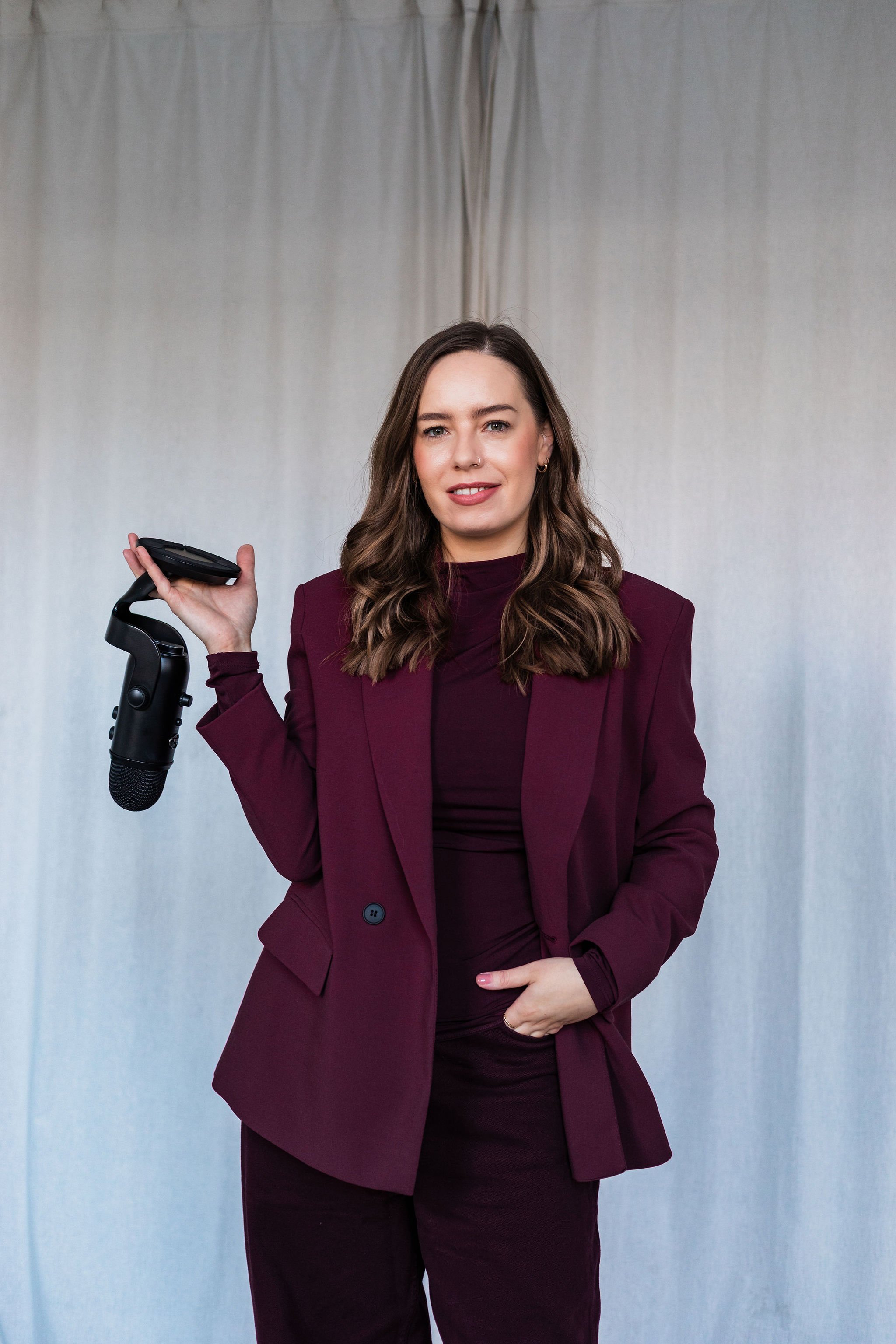
The Art of Confident Content is planned, edited and produced by Rebecca at Robin Rose Creative (that’s me in the pic!). If you've been thinking about launching your own podcast and want support bringing it to life, get in touch here. I'd love to hear about your idea and discuss how I can help you with the concept, episode ideation and launch content.
You’ll find previous podcasts planned, edited and produced by Rebecca here:
